
Uncategorized
A Complete Guide to Modern Forklift Battery Chargers

The Future of Electrified Forklifts: A Complete Guide to Modern Forklift Battery Chargers
For mobile equipment and logistics professionals, battery chargers often conjure images of bulky, immobile boxes lining the warehouse walls, dutifully powering fleets of forklifts. But as electrification continues its advance, the reality is that modern charging solutions have evolved beyond these static, plug-and-play devices. Today, conversations on industrial chargers often turn to their innovative alternatives.
What sets these modern charging solutions apart from their traditional counterparts? More importantly, how can industrial professionals leverage this knowledge to create more versatile, sustainable, and efficient operations?
To answer these questions, first, we must understand the evolution of charging technology in industrial sectors.
Forklift Wall Chargers: Treading Familiar Ground
Electric forklifts and lift trucks have relied on transformer-based, wall- or rack-mounted chargers for decades, particularly those operating indoors or with limited outdoor excursions. These have a few defining characteristics, as they are:
- Designed originally for industrial lead-acid batteries
- Ideal for indoor operations with sufficient real estate to house them
- Simple to maintain with few parts aside from the transformer itself
The stationary nature of these chargers matches the operational patterns of forklifts, which typically return to a consistent location for charging after a day’s work. At the same time, they also have glaring setbacks that have necessitated strategic redesigns.
The Shift to Onboard Charging

Mirroring the trend seen in Mobile Elevating Work Platforms (MEWPs)—such as single-person lifts, scissor lifts, and boom lifts—and floor care machines, modern lift trucks have started adopting onboard chargers as they venture outside the familiar warehouse.
This transition emerges in response to one of electrified machinery’s biggest weaknesses: range anxiety. Battery-powered equipment historically lacked the operational freedom of traditional internal combustion engine (ICE) vehicles, raising concerns over what would happen if it lost charge far from its charging station.
Onboard chargers solve this with their unique design, which:
- Allows for charging through any standard AC outlet
- Eliminates the need to relocate charging infrastructure
- Enables offsite or extended-range operations
Beyond the enhanced versatility, onboard chargers free up valuable space; warehouses no longer need a dedicated charging room, enabling more efficient use of existing resources.
Evolving EV Charging Infrastructure
Since the advent of electric passenger vehicles, we’ve seen increased growth in EV charging stations, populated by individual EV “chargers.” Interestingly, these are technically not chargers at all—but Electric Vehicle Supply Equipment (EVSE).
Rather than charging the vehicle battery directly, EVSE acts as a middleman for safe, efficient power transfer—whether that’s to a passenger EV or an electrified front loader. Think of EVSE as sophisticated wall boxes that negotiate the charging process, while still relying on the vehicle’s onboard charger to actually charge the battery.
Besides DC fast charging (which we’ll cover next), EVSE supports two levels:
- Level 1 – 120 VAC. Most commonly utilized in residential homes.
- Level 2 – 208 – 240 VAC. Ideal for recharging industrial machinery.
In 2022 alone, global charging infrastructure grew 33% to 2.7 million public charging points. In the US, some 80% of these EVSE are Level 2, indicating a trend towards the higher power levels needed for electrified mobile machinery.
DC Fast Chargers: The Promising Future
Unlike Levels 1 and 2, which utilize AC power, DC fast chargers provide direct current (DC) at higher voltages (currently 400-800V DC) to charge EV batteries in minutes instead of hours.
Also, unlike AC EVSEs, these are chargers in the truest sense of the word. DC fast chargers supply the necessary voltage and current directly to the battery, bypassing the vehicle’s onboard charger.
In addition, they provide this power at a very high rate—typically on a pace to recharge the pack within one hour. This speed is enabled by current and future lithium battery technologies only; no other battery chemistry can charge at these rates.
Yet, while DC fast charging seems promising, implementation remains challenging for several reasons:
- Thermal management – Rapid charge rates generate significant heat. Advanced charging solutions, such as Battery Management Systems (BMS), are necessary to prevent battery degradation and maintain safe temperatures.
- Infrastructure requirements – The high power demands of DC fast charging require robust electrical infrastructure, which can be challenging to access and costly to install.
- Compatibility and standardization – Despite strong advancements in electrification, the underlying architecture—cabling, ports, and plugs—still lacks unified standards.
Although DC fast charging is currently out of reach for most non-road machines due to supported voltages, the expansion of 800V DC charging infrastructure indicates that this technological gap is actively being filled with machines moving up to those voltages as well.
Lithium Chargers: What Are They?
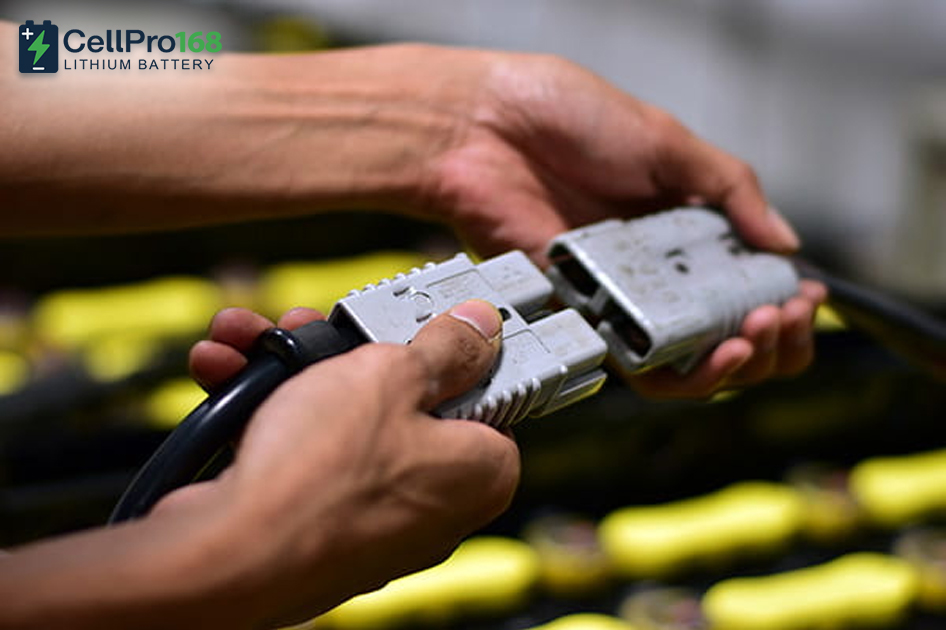
Electrified machinery usually operates with lead-acid batteries, particularly in material handling and MEWP sectors. That’s been the case for decades—but lithium-ion is changing that.
Why depart from the tried and true? In short, lithium-ion isn’t simply another battery option. It’s a direct upgrade.
Lithium-ion’s superiority can be demonstrably proven by facts and figures:
- Energy density – Lithium-ion batteries can store more energy in a smaller, lighter package—up to 7x more than lead acid—making them ideal for energy-intensive industrial applications.
- Efficiency – Lithium-ion batteries boast an energy efficiency of 95% or more versus lead-acid’s average of 75%, allowing for greater usability (and reduced waste) of stored power.
These benefits are compounded by the right charging solution.
In contrast to lead-acid’s relatively uniform charging characteristics, lithium charging can be calibrated to precisely meet the machinery’s application. In fact, lithium batteries can benefit from the intelligent charging of a Battery Management System (BMS), optimized in real-time according to external temperature, infrastructure, and other factors.
This is why lithium chargers are exclusive to lithium batteries. Both charger and BMS must speak the same “language” to ensure a safe and efficient charge—a significant departure from lead-acid batteries, which lack communication capabilities.
Forklift Battery Chargers: The Electric Implications
Electrification itself is nothing new. But the advancements it sparked continue to redefine the mobile equipment and logistics landscape.
As electrification takes hold in a growing number of industries, innovative charging solutions will likely push the boundaries of what’s possible. Already, we see evidence of this in the trend toward onboard chargers and the apparent opportunity to leverage DC charging in MEWP and lift machinery applications.
By keeping an eye on the future and deepening your understanding of these emerging technologies right now, you’ll be better positioned to seize the opportunities they present. And the next time you hear the word “charger,” you might just have a new perspective to share.
